

I have embarked on a misguided crusade.
Nothing noble enough to require a horse. I’m vegan; I’d never require a horse. Just me, a Facebook feed, and an increasingly inconvenient question:
“Where’s the link to buy the physical product?”
Followed, when appropriate, by:
“How much is shipping?”
These are ordinary shopping questions. Somehow, they become deeply disruptive when directed at an advertisement full of objects that apparently do not exist.
Lately, my feed has been serving me books. Beautiful books. Thick books. Books with spines, shadows, and the apparent structural integrity to remain upright on a desk. Beside them: little cases of physical media, printed reference guides, and coordinated accessories arranged into an educational boutique.
Some of these images look AI-generated. Others might be mockups or actual printed demonstration copies. I cannot establish the provenance of every suspicious paperback in my feed.
But I can click the offer.
Seven-dollar download.
Twenty-seven-dollar download.
An entire desk full of merchandise has been reduced to an email attachment.
Ma’am, you are a ZIP file.
I Would Like the One With Atoms
I like physical things.
A reference book can sit beside my computer while I work. A printed guide can live under my keyboard. An SD card can go into a device. These are useful qualities, and an advertisement depicting them has successfully attracted my interest in precisely those qualities.
There is also a difference between being able to read something and having to drag along a charged device to read it. Devices are fine. Charged devices are another matter entirely. I work in a phone store, and somehow my own phone is always dead. If the book is physical, I can pick it up whenever I want. If it is digital, I have to locate the device, find a charger, and hope the battery has not chosen this exact moment to become a historical artifact.
Congratulations. Your marketing worked.
Now where do I buy what you showed me?
This is where the atmosphere occasionally becomes delicate.
Apparently, I was supposed to admire the lovingly staged physical product without developing any expectation of receiving it. The paper was conceptual. The binding was aspirational. The shipping department is a metaphor.
My apologies. I saw a person holding a book and assumed the book had entered commerce.
The Download Has Rack Screws
My least favorite offenders are DAW audio plug-ins. They seem to do this more than anyone else.
An advertisement presents a gorgeous new hardware device: brushed metal, substantial knobs, glowing meters, dramatic lighting. It looks expensive. It looks heavy. It looks like something I should check the dimensions of before rearranging my desk.
How is it powered?
What external physical interfaces does it use?
What inputs and outputs does it have?
Does it come with the cable?
Oh. It’s a plug-in.
The rack screws are decorative. The metal is emotional support. Installation requires a password, and the only thing taking up physical space is my disappointment.
I understand why software interfaces resemble familiar equipment. Knobs and meters are useful. But somewhere between designing the interface and presenting the advertisement, somebody could prominently mention that the chassis is made of pixels.
“DAW AUDIO PLUG-IN. NO HARDWARE INCLUDED.”
There. We’ve cleared customs.
A Picture Can Explain What You Sell
I saw another music-production advertisement that simply said, “Study Music Production Online,” over a picture of a mixing console.
Perfectly clear. I understood the offer immediately. Nobody needed to explain that tuition did not include freight delivery of a recording studio.
The wording and the image worked together.
That is entirely possible. We have the technology. Apparently, it even predates artificial intelligence.
What bothers me is the presentation of a specific, branded, physical bundle when the available purchase is a download. Some examples are ambiguous. Some, to my eye, are flagrantly misleading.
And “everybody does it” is a fascinating defense from an industry that charges people to learn how to stand out.
Shipping Costs?
So I have begun asking.
Politely. Enthusiastically. With the unbearable optimism of a woman who believes a photographed object might be available for purchase.
“Books, SD cards, and a mousepad guide seem amazing. Where’s the link to get a physical copy?”
“Shipping costs?”
“It’d look cute sitting on my desk.”
I recognize that this is a ridiculous use of my finite time on Earth. Somewhere, laundry remains unfolded while I interrogate the supply chain of an imaginary textbook.
Nevertheless, the question deserves an answer.
If there is a printed edition, wonderful. Send the link. If there isn’t, say so clearly in the advertisement. A digital product can be useful, beautiful, and worth buying on its own terms.
Give me a reason to want the download.
Because if you show me a book with a spine, pages, and a place on somebody’s desk, I may develop the outrageous ambition of owning that book.
And then we will have to discuss shipping.
For something with no physical inventory, this is becoming remarkably difficult to deliver.

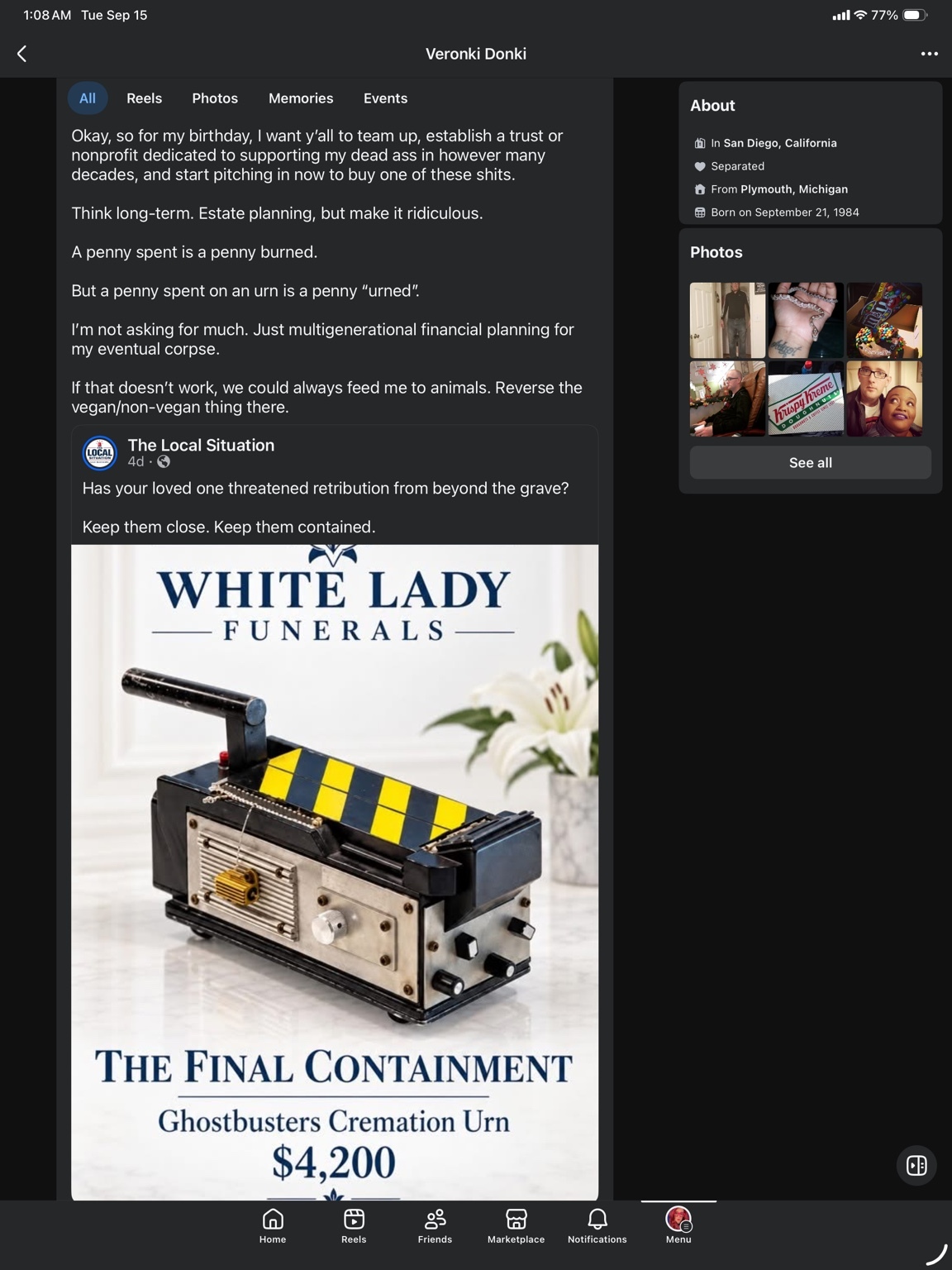





 SURPRISE, MORTAL.
